Showing posts with label korea. Show all posts

Tuesday, April 10, 2012

My first book: Jalan-jalan Kpop is finally published!!

Hi blog, hi readers, long time no see...I miss writing here. Nowadays I'm super busy with thesis preparation, so it's really difficult to find time to do my hobby, which is blogging. Kinda sad, but that is life^^;

Luckily during these busy time, I still could manage to join a writing project, which was about Kpop concerts and Kpop stuffs in Korea, such as merchandise shops, how to buy concert tickets in Korea, how to visit Kpop celebs' shops, how to watch live broadcast of Kpop music shows, etc. With 4 of my friends (Widhi, Atri, Ramski & Anda), finally we got our first book published by Gagas Media, a famous publisher for teen books. This book was written in Indonesian and priced Rp 45.000. It's now available on bookstores in Indonesia^^ Please enjoy it!


In Indonesian:
Akhirnya saya & 4 teman saya berhasil menulis pengalaman kami berlima nonton konser demi konser di Korea. Walau artis Kpop sudah banyak yang ke Indonesia dan negara lain, menurut kami tetap saja menonton di Korea sangat menarik. Di buku ini kami berlima menuangkan pengalaman nonton konser tunggal dan konser borongan macam SM Town atau Dream Concert, cara2 membeli tiket konser di Korea, cara menonton acara musik seperti Music Bank, Mnet Countdown, Music Core & Inkigayo, serta panduan berkunjung ke toko2 milik artis seperti Handel & Gretel (Yesung), Page One (T-ara), Kona Beans, tak lupa cara berkunjung ke toko merchandise & CD seperti Everysing dan Hottracks. Buku ini sudah mulai beredar tanggal 7 April di toko-toko buku di Indonesia dengan harga Rp 45.000 saja. Selamat menikmati petualangan menonton konser di Korea ya^^ Sampai jumpa di Korea~~~

Tuesday, July 6, 2010

World Students in Korea (WSK) 3rd Batch Camp (Day 1)

Hi^^
This year the summer in Korea is as hot as last year! We, the WSK 3rd batch were having a 2 days camp in Gunsan and Jeonju, and fortunately the weather during our camp wasn't hot! It even rained, and according to the guide (Ms. Sujin), Korea has that kind of "rainy season" which lasts for several days during summer^^

So, on Friday July 2nd, we departed from Apgujeong, heading south to Gunsan which took about 3 hours. It was a long but fun trip.

Our huge bus^^

Arrived in Gunsan, an industrial estate, reminded me of Kawasan Industri MM2100 in Cibitung where I used to work before. We watched a short introductory movie of Hyundai Heavy Industries, and later we visited the ship-building factory. I was so impressed by the large size of the ships and the components. Since we couldn't take pictures, so I don't have the pics in that ship-building factory.

After that, we had lunch in a nice Korean restaurant. The menu were beef stew and tuna for those who don't eat beef. It was a nice lunch^^

Then, we continued to visit another Hyundai factory, which was Wind Turbine factory. Again, we were fascinated by the technology that Korea has. In the exhibition hall, we saw the samples of the wind turbine components, such as solar modules, solar inverters, generators, etc. After that, we had a chance to visit the wind turbine assembly factory. It's very huge compared to the assembly factory of electronics products *of course!*

Finishing our company visit, we headed to Jeonju Hanok Village, a very beautiful place with traditional nuance. We visited Jeonju Traditional Wine Museum where we tried to make makgolli (Korean traditional rice wine). The smell is like Indonesia's air tape, but I didn't try the taste^^
Beautiful, isn't it?

Me & Shwe from Myanmar tried to filter the fermented rice to make makgolli.

From the museum, we moved to our traditional inn named 부용헌 (Buyongheon). I liked it very much!! It was so soothing...
The inn

We were assigned to a group of 3, and my roommates were Dewi from Indonesia and Hu from China. Look!  The room was very cozy and the folded bed had a beautiful color^^

At night, we had a dinner of Jeonju's specialty, bibimbap. It was delicious^^
Then, we had a game in which we're divided into 3 groups, and we chose Sian, our magnae as the representative, hehehe...

Nice move, Sian XD

Ending the 1st day, we enjoyed pansori ( a kind of Korean traditional music) and also traditional music performances. Some of the music was so soothing that made me sleepy^^ but some were energetic and cheerful. I had a great time.

Gayageum and janggu performance

An ensemble of gayageum, janggu and sogeum (I don't know the name of one wind instrument)

Pansori. This lady was very attractive and she sang very well.

Quite a long day, wasn't it? That night, we Indonesian girls (Dewi, Sian, Widhi & I) took a long walk along the street to find some karaoke place, but we found none^^ So we went back to our inn. I watched soccer match between Netherlands vs Brazil in Sian/Widhi's room^^ Yeah, Indonesians love soccer!

That's all for the 1st day and I'll be back with the report of our 2nd day trip. Thanks for reading and commenting!

Wednesday, May 26, 2010

The Magical Beauty of Hanbok

taken from here

There are many things that may represent Korea. One among them is the Korean traditional dress “hanbok.”

Although nowadays few people wear hanbok except on national holidays like New Year’s Day, the beauty and elegance of the garment is always amazing. 

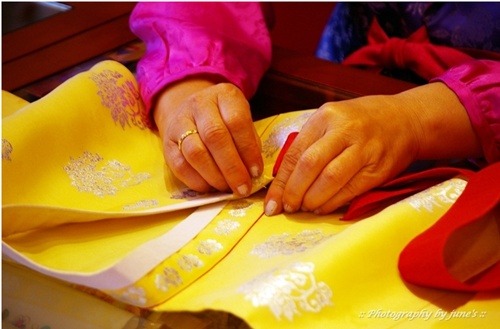
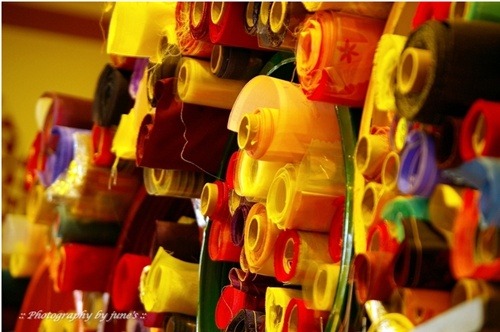
Stitch by stitch, making a beautiful hanbok takes great craftsmanship, effort, and passion. It depends on how you choose the right combination of colors among infinite possibilities; how you cut, fold, stitch up patches of cloth together; how you sew patterns onto it, etc.

Hanbok has some magical quality about its color and texture that even the modern digital technology can’t really simulate on the screen. 

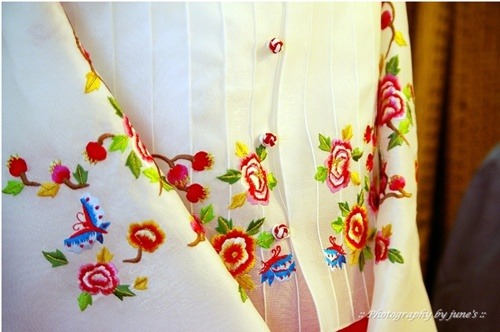
Patterns of flowers and butterflies sewn into the cloth radiate the artist’s craftsmanship and subtlety. Wearing hanbok, you can just feel the artist’s heart oozing out of it. There are no fixed set of rules or formula to follow in making hanbok. How the garment is rendered is solely at the discretion of the hanbok-maker.

Hanbok takes into account the wearer’s body shape, comfort, and beauty, all at the same time. It is one of Korea’s greatest assets containing its people’s indelible, age-long wisdom.

Despite the garment’s much fallen popularity among people nowadays, the passion and perseverance of hanbok artists endures.

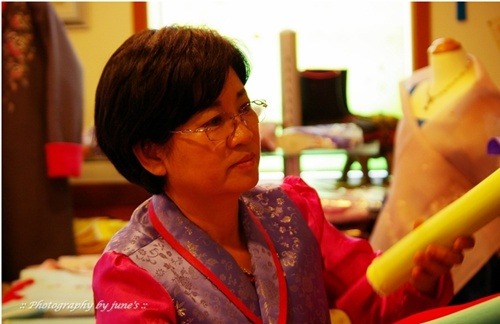
Hats off to the hanbok makers – protectors of one of the most precious Korean assets.

Thursday, May 13, 2010

World Students in Korea (WSK)

Good night^^

Okay, I think I haven't announced that I have been selected as a member of World Students in Korea (WSK)
*throws confetti*
WSK is an international students program run by the Presidential Council on Nation Branding (PCNB) since June 2009. You can take a look at the website in Koreabrand.

As the member of WSK, the students' main task is to run individual blogs to promote cultural exchange and to strengthen ties between Korea and our own home countries. As an exchange, the Council will provide us opportunities to visit Korea's cultural heritage sites, major industrial sites, and workshop.

Until now, there have been 2 batches of this program, and I'm the member of the 3rd batch. On May 4, 2010 we attended the kick-off ceremony for the 3rd batch and also closing ceremony for the 2nd batch. It was held at the National Museum of Korea. We had an awarding ceremony for best bloggers of the previous batch. After that, we had a free museum tour. It was so amazing tracing the history of Korea. However, because we didn't have much time, we finished the tour in short time. I think I'll visit the museum again to satisfy my curiosity to explore the whole museum^^

This is the pic of the kick-off & closing ceremony. Thanks Ms. Shin of WSK who sent me this pic^^


The building of National Museum of Korea. It was so grand, beautiful, and crowded!
I will blog about this place next time, so please keep on reading and commenting my blog^^ See you!

Sunday, May 9, 2010

Watching Cherry Blossom (17-18 April 2010)

When I first came to Korea, I didn't know that Korea also have cherry blossom (sakura). In Korea, it's called   벚꽃(potkkot). So when I found out that Korea have it, I was really happy ^^. This year was the second time I went to see the cherry blossom. My friends and I went to Hangang Park Yeouido and around the National Assembly. As expected, it was soooo crowded! But I still enjoyed the view since it wouldn't last long :(
By the way, Korea's cherry blossom is white or pinkish white, different from Japan's.


I took this picture at Yeouido, near 63 Building. We had a walk along the street and enjoyed the view. I like how the trees made a formation like this^^


This was near the National Assembly. As usual, a lot of people came. This year the flowers were blooming late, so this event was a long-awaited one.

I like how the flowers took up the space and covered the street sign.


People: young, old, families, lovers, friends..All of them poured to the park enjoying the annual beautiful scenery.


The grand building of National Assembly across the line of cherry blossom trees. Double beauty.


There are also cherry blossom trees in my university. This was taken at Ewha Elementary School that is located behind my dorm. Beautiful, aren't they?

I hope you enjoy reading and seeing the pics^^
See you again in my next post!

It (cherry blossom) is beautiful because it doesn't last long (NEWS - Sakura Girl)

Wednesday, May 5, 2010

Korean NGOs Reach Out to the World

taken from here

There are Korean NGOs (Non-Governmental Organizations) that aid the poor and the ill, give hope to the despaired around the world. Southeast Asia, Africa, Central America, South America….anywhere they are needed, Korean volunteers reach out their helping hands.

Many of the Korean NGOs work overseas, providing the recipient countries with charity funds. Some of those funds come from the ODA (Official Development Assistance) of the Korea Overseas Cooperation Agency (KOICA).

KOICA was founded as a government agency in 1991 to maximize the effectiveness of Korea’s grant aid programs for developing countries. The agency manages grant aid and technical cooperation programs, as well as the Economic Development Cooperation Fund (EDCF) through which concessional loans for development projects are provided to the governments of developing countries.

And there is KCOC (Korea NGO Council for Overseas Cooperation), an association of 66 development NGOs. They engage in implementing development and aid projects with the aim to eradicate poverty around the world. The number of its members has doubled since 1999.

With the ultimate goal of meeting the suggested volume set by the OECD, Korea plans to expand its size of ODA first to 0.15% of its GDP by 2012 and to 0.25% by 2015. There isn’t a comprehensive statistics on the volume of aid and the number of members of Korean NGOs, but the volume of the government grants for NGOs is estimated to be USD 6.47 million. The NGOs also take donations from private companies, religious organizations, and individuals.

In May 2009, the Korean Government launched “World Friends Korea,” a consolidated brand of Korea’s overseas volunteer groups, to generate synergy and to facilitate the management of volunteer activities on a national level. This also was one of the 10 key projects undertaken by the Presidential Council on Nation Branding.

Notable NGOs of Korea
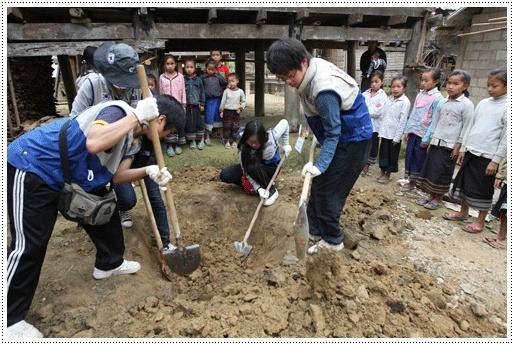
A Korean NGO’s volunteers, photo courtesy of www.koreabrand.net

Some of the most active Korean NGOs abroad include the World Vision, Good Neighbors, and Join Together Society.

The World Vision is a relief, development and advocacy organization dedicated to working with children, families and their communities to address the causes of poverty and injustice. Their work includes educating children, emergency relief, agriculture and medical support among various others.

Good Neighbors International is an international humanitarian and development organization originated in 1991 from Seoul, Korea. In the beginning it concentrated on projects such as helping orphans and handicapped children, finding homes for disadvantaged widows, rural community development, and assisting disadvantaged families of TB patients in Korea.

But over time it has become an organization offering assistance to anyone in need regardless of race, nationality, religion, ideology, or geographical constraints. For example, Good Neighbors International has been particularly involved in the Rwandan refugee situation. It has been providing several medical relief teams and the operation of two non-formal schools at the refugee camps since 1994.

In 1996, Good Neighbors International became the first international NGO from Korea to receive General Consultative Status, the highest status level, from the United Nations Economic and Social Council.
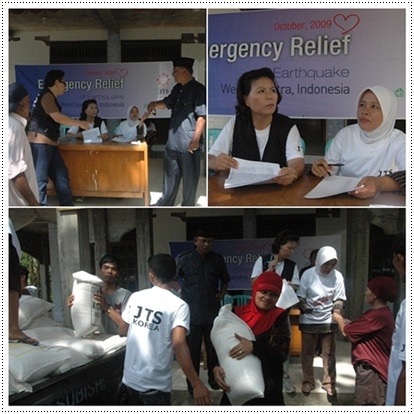
JTS emergency relief team at the 2009 earthquake in Indonesia (www.jts.or.kr)

The Join Together Society is an international relief agency established in 1993 for eradicating famine, disease, and illiteracy. Its work includes village development, emergency relief, providing primary education, medical clinics, and assistance to North Korea.

Some other Korean NGOs include the Korea Food for the Hungry International, the GCS Club, Korea International Volunteer International and others.

The efforts to help and share with those in need around the world – Keep it up, Korea!