Thursday, May 13, 2010

World Students in Korea (WSK)

Good night^^

Okay, I think I haven't announced that I have been selected as a member of World Students in Korea (WSK)
*throws confetti*
WSK is an international students program run by the Presidential Council on Nation Branding (PCNB) since June 2009. You can take a look at the website in Koreabrand.

As the member of WSK, the students' main task is to run individual blogs to promote cultural exchange and to strengthen ties between Korea and our own home countries. As an exchange, the Council will provide us opportunities to visit Korea's cultural heritage sites, major industrial sites, and workshop.

Until now, there have been 2 batches of this program, and I'm the member of the 3rd batch. On May 4, 2010 we attended the kick-off ceremony for the 3rd batch and also closing ceremony for the 2nd batch. It was held at the National Museum of Korea. We had an awarding ceremony for best bloggers of the previous batch. After that, we had a free museum tour. It was so amazing tracing the history of Korea. However, because we didn't have much time, we finished the tour in short time. I think I'll visit the museum again to satisfy my curiosity to explore the whole museum^^

This is the pic of the kick-off & closing ceremony. Thanks Ms. Shin of WSK who sent me this pic^^


The building of National Museum of Korea. It was so grand, beautiful, and crowded!
I will blog about this place next time, so please keep on reading and commenting my blog^^ See you!

Sunday, May 9, 2010

Watching Cherry Blossom (17-18 April 2010)

When I first came to Korea, I didn't know that Korea also have cherry blossom (sakura). In Korea, it's called   벚꽃(potkkot). So when I found out that Korea have it, I was really happy ^^. This year was the second time I went to see the cherry blossom. My friends and I went to Hangang Park Yeouido and around the National Assembly. As expected, it was soooo crowded! But I still enjoyed the view since it wouldn't last long :(
By the way, Korea's cherry blossom is white or pinkish white, different from Japan's.


I took this picture at Yeouido, near 63 Building. We had a walk along the street and enjoyed the view. I like how the trees made a formation like this^^


This was near the National Assembly. As usual, a lot of people came. This year the flowers were blooming late, so this event was a long-awaited one.

I like how the flowers took up the space and covered the street sign.


People: young, old, families, lovers, friends..All of them poured to the park enjoying the annual beautiful scenery.


The grand building of National Assembly across the line of cherry blossom trees. Double beauty.


There are also cherry blossom trees in my university. This was taken at Ewha Elementary School that is located behind my dorm. Beautiful, aren't they?

I hope you enjoy reading and seeing the pics^^
See you again in my next post!

It (cherry blossom) is beautiful because it doesn't last long (NEWS - Sakura Girl)

Friday, May 7, 2010

My dorm at Ewha

Good night all^^
Tonight I'll show you my room at Ewha Graduate Student Dormitory.
It's located inside the campus, near Ewha Children Center & students' cafeteria.

I'm sharing the room with another Indonesian student, Atri. I was glad of that, because it made me easier in adapting rather than sharing the room with student from other country^^;
Ah, one thing, pictures below are taken by Atri, and she kindly allowed me to share them here.

Aliens' room^^. Why I call myself as an "alien"? It's because as a foreigner, I have to report to the Immigration and obtained "Alien Registration Card". I wonder which other countries use the term "alien" for "foreigner"? So unique^^

When I entered my room for the first time, I wondered. "Isn't it a hotel room?" XD
I mean, look at the bathroom! It has 24-hour hot water! And look at those big mirror, you'll know what I mean...

Go out of the bathroom and turn left, there are a shared mini fridge and my closet^^. The fridge can store our raw food stock for 1 week, but we put all the spices on top of it since the fridge is always full.

My roommate's bed. I couldn't put mine because it's too messy now hehehe... She likes Super Junior and put their poster on her wall. On the other side of the wall, there are controllers for air conditioner (used in summer) and heater (used in winter). So convenient!


Lastly, here is the spot where we spend the time most, the desk! *drumrolls*
 High speed 24-hour internet is provided, so it makes us easier in searching for materials for our assignments...I am so amazed by Korea's high speed internet, and I think I will miss it a lot when I go back to my country T^T


Hmm okay, I think that's all for tonight. I'll post again tomorrow, with different topic. I hope you enjoy visiting my blog and don't forget to follow me if you have Blogger account^^

Wednesday, May 5, 2010

Korean NGOs Reach Out to the World

taken from here

There are Korean NGOs (Non-Governmental Organizations) that aid the poor and the ill, give hope to the despaired around the world. Southeast Asia, Africa, Central America, South America….anywhere they are needed, Korean volunteers reach out their helping hands.

Many of the Korean NGOs work overseas, providing the recipient countries with charity funds. Some of those funds come from the ODA (Official Development Assistance) of the Korea Overseas Cooperation Agency (KOICA).

KOICA was founded as a government agency in 1991 to maximize the effectiveness of Korea’s grant aid programs for developing countries. The agency manages grant aid and technical cooperation programs, as well as the Economic Development Cooperation Fund (EDCF) through which concessional loans for development projects are provided to the governments of developing countries.

And there is KCOC (Korea NGO Council for Overseas Cooperation), an association of 66 development NGOs. They engage in implementing development and aid projects with the aim to eradicate poverty around the world. The number of its members has doubled since 1999.

With the ultimate goal of meeting the suggested volume set by the OECD, Korea plans to expand its size of ODA first to 0.15% of its GDP by 2012 and to 0.25% by 2015. There isn’t a comprehensive statistics on the volume of aid and the number of members of Korean NGOs, but the volume of the government grants for NGOs is estimated to be USD 6.47 million. The NGOs also take donations from private companies, religious organizations, and individuals.

In May 2009, the Korean Government launched “World Friends Korea,” a consolidated brand of Korea’s overseas volunteer groups, to generate synergy and to facilitate the management of volunteer activities on a national level. This also was one of the 10 key projects undertaken by the Presidential Council on Nation Branding.

Notable NGOs of Korea
A Korean NGO’s volunteers, photo courtesy of www.koreabrand.net

Some of the most active Korean NGOs abroad include the World Vision, Good Neighbors, and Join Together Society.

The World Vision is a relief, development and advocacy organization dedicated to working with children, families and their communities to address the causes of poverty and injustice. Their work includes educating children, emergency relief, agriculture and medical support among various others.

Good Neighbors International is an international humanitarian and development organization originated in 1991 from Seoul, Korea. In the beginning it concentrated on projects such as helping orphans and handicapped children, finding homes for disadvantaged widows, rural community development, and assisting disadvantaged families of TB patients in Korea.

But over time it has become an organization offering assistance to anyone in need regardless of race, nationality, religion, ideology, or geographical constraints. For example, Good Neighbors International has been particularly involved in the Rwandan refugee situation. It has been providing several medical relief teams and the operation of two non-formal schools at the refugee camps since 1994.

In 1996, Good Neighbors International became the first international NGO from Korea to receive General Consultative Status, the highest status level, from the United Nations Economic and Social Council.
JTS emergency relief team at the 2009 earthquake in Indonesia (www.jts.or.kr)

The Join Together Society is an international relief agency established in 1993 for eradicating famine, disease, and illiteracy. Its work includes village development, emergency relief, providing primary education, medical clinics, and assistance to North Korea.

Some other Korean NGOs include the Korea Food for the Hungry International, the GCS Club, Korea International Volunteer International and others.

The efforts to help and share with those in need around the world – Keep it up, Korea!

Tuesday, May 4, 2010

Happy Life, Seoul!

taken from here
Seoul, the largest city of the Republic of Korea with a population of over 10 million, became the capital of the country during the Joseon Dynasty (1394).

Since then it has become an undoubted global city where the 1986 Asian Games, the 1988 Summer Olympics, and the 2002 FIFA World Cup were held. And the city will host the G-20 Summit 2010 in November and the Nuclear Security Summit in 2012.

Let’s look into the quality of life of those living in Seoul. 

The Seoul Metropolitan Government published the result of a survey on Seoul, conducted on 20,000 households (46,153 people aged over 15) and 2,500 foreign residents in October 2009. According to the survey, the degree of satisfaction the subjects felt for their “Health Condition” and “Financial Condition” was found out to be increasing year after year.

“Residential Environment” scored 5.90 points (out of 10.00), “Social Environment” 5.40, “Economic Environment” 5.08, and “Educational Environment” 4.95, indicating a bit of an increase compared to the previous year (2008). In terms of “Public Transportations,” too, there was an increase of satisfaction by 0.22 points, and the safety of the city was also found out to be rising annually.

The volume of donation from the Seoulites has been expanding since 2006 despite the tough financial conditions, and so has the participation rate in volunteer work, suggesting the culture of volunteerism is spreading in Seoul.

Preparation for seniorhood is also in better shape, compared to the previous year. Senior population’s engagement in social activities on a regular basis is increasing, and the number of seniors who wish to live in senior housings instead of living on their own is rising.

The Seoul Metropolitan Government will reflect these findings of the survey in its policy making.
Hope more and more people will come visit Seoul, a global city that doesn’t stop getting better!

Thursday, March 25, 2010

First semester in Ewha (March 2009)

After a warm welcoming ceremony, we started classes next day. I was happy because my major, Health & Environment, had a lot of field trips to Korean facilities like Korean National Tuberculosis Association, Asan Medical Center, The Sihwa Constructed Reed Wetland, Silvercare (health care for elderly), etc. Those experiences enriched my knowledge in health & environment practice. I will write about my field trips experiences later, and now I'll write my impressions about Ewha.

At first, I didn't know that Ewha Womans University (or nicknamed as 이대 /idae) is a top university in Korea, because I never browsed about universities in Korea before ^^. So I was grateful when knowing that Ewha is one of the top universities. Moreover, it's the best women's university in Korea. I was quite shock during the first weeks, because most of the girls in here dress very beautifully, as if they are celebrities. But as time goes by, I could get used to it.

Ewha is located in Daehyun-dong, Seodaemun-gu, Seoul and is exactly located in the end of shopping districts. You can find coffee & tea shops, clothing, shoes, cosmetics and a bunch of Korean and international restaurants around here, so whenever you get bored in your room, you can just step out and find a place to sit and enjoy the view of shoppers (or passers-by) ^^.

The above pic is what will you see after entering Ewha's main gate. The big building at the left side is 대강당 / Welch-Ryang Hall, the hall we use for graduation and admission ceremony (and also for concerts, hehe). The smaller building which looks like a house from middle-age is Clara Hall. Sometimes I dream of having a house like that XD.
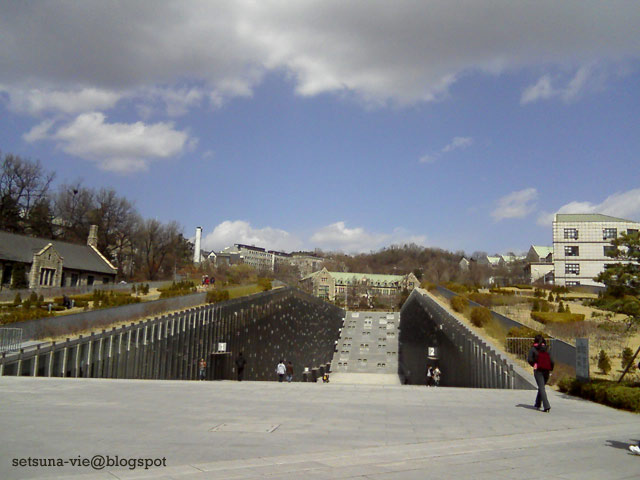
When you turn right, you can see Ewha Campus Complex (ECC) which is an integrated buildings. It consists of 4 floors that has reading rooms, classrooms, a lot of student's lounges, a gym, a conference and exhibition hall, restaurants, a movie theatre, coffee shops like Starbucks, Richemont bakery, convenience stores, and also facilities like Shinhan Bank, Starbucks, Canon printing center, Kyobo bookstore, etc. It's like a one-stop service for students.

Can you see the building at the end of the stairs? This is the picture of it.

It's Pfeiffer Hall, the main hall. I think it's also one of the most recognized building in Ewha besides Welch-Ryang Hall and ECC. But unfortunately I never have a chance to enter the building. It's a grand building, isn't it?

I can't put all the buildings' picture in this post because it's labeled as "spring", but I'll post more pictures in different posts ^^
See you!


Wednesday, February 24, 2010

Touch down in Korea (26.02.2009)

Hmm, I'm trying my best to recall my memory. I left Jakarta on February 25th, 2009 and landed in Seoul the next morning. The flight wasn't so smooth as we kept on being in bad weather and had to fasten our seat belt. Being our first time to Korea, the four of us (Au, Atri, Ludi & me) felt lost, but luckily Atri's friend, Ayu, came to pick us at the airport. Then she took us to our soon-to-be home for 1.5 years, Ewha Womans University (I'll tell you the details about my university later, hehehe). Although winter had ended, but the temperature was still low that we felt freezing. It's natural for us who come from a tropical country like Indonesia, isn't it? The first sensation was like..."Wow, I felt like being in a giant freezer!" LOL. We were suffering but trying to get used to it.

Arrived at our dormitory after dragging our suitcases for about 200 meters from the bus stop, we registered to the office and got the password number of our rooms. I was placed in the same room with Atri at room A415, while Au was with Ludi at A506. We were so amazed with the convenience at our rooms. They look like hotel rooms! You can take a peek here (I'm gonna post the pics of my room later).

The next day, we attended the opening ceremony for our program, Interdisciplinary Program of Technology and Development. We had a briefing and lunch with the Dean, Professors, and assistants.

First time is always good! I enjoyed the Korean foods they served on that welcoming ceremony, but I had to be extra careful because most of Korean foods use pork that I'm forbidden to eat.
Also, I fell in love at the first sight with Ewha's landscape. The campus has a Western style buildings, being it as a product of an American missionary project. The campus is a blend of beautiful buildings with 1800s' style and modern buildings such as ECC (Ewha Campus Complex) that becomes the most attractive building at Ewha.

I just realized I don't have the buildings' pics in this computer *LOL*, so I took one from wiki ^^.
And this was our first pic with ECC on the background..From left to right: Au - me - Ludi - Atri.

Okay, that's all for the "first" theme. I'll write more about what I experienced during my 2009's spring next time. See you!